Segovia day trip from Madrid: our highlights and travel tips
All you need to know to plan a day trip to Segovia. What to see, where to go and what you need to know to plan the perfect Madrid to Segovia day trip
Segovia is one of the most popular day trips from Madrid.
A historical town and UNESCO World Heritage Site, Segovia is a short train ride away from Madrid and one of the most beautiful small towns in Spain.
It is the perfect destination for lovers of history and castles especially but it is also a very pleasant city for a stroll.
This is all you need to know to plan a visit to Segovia and why we believe you should visit this lovely corner of Spain.
What is Segovia famous for?
Segovia is a historical town not far from Madrid famous for an imposing Roman aqueduct, an impressive Alcazar and a culturally significant old town centre.
The main things to see in Segovia are of historical nature and the city is a great day trip from Madrid for anyone interested in history and food: Segovia’s food is legendary!
Segovia’s patrimony is UNESCO World Heritage Site and the city features regularly among one of the best day trips from Madrid together with Toledo, another city we loved.
Where is Segovia
Segovia is a town in Castilla y Leon, the region of Spain just North of Madrid.
The town has roman origins and has been inhabited since the year of foundation.
Over the centuries, it acquired many beautiful and significant buildings and landmarks that eventually brought the UNESCO to recognize it as a world heritage site.
Its most impressive traits are a mind blowing Roman aqueduct and a fairy tale royal palace called the Alcazar.
How to get from Madrid to Segovia: bus or train?
Segovia is located to the North West of Madrid and you can reach it by bus or train.
The website for the bus service is called ‘La Sepulvedana‘ and the one for the trains is Renfe.com.
We found the bus website confusing and difficult to consult so we opted for the high speed train which was pricey but excellent.
Segovia from Madrid by train
Trains depart almost hourly from Madrid Chamartin station and connect the two cities in less than half an hour (at the time of writing, one-way tickets Madrid to Segovia cost 20 Euro, advance booking is recommended).
Chamartin station has some handy automatic ticket machines but when we tried to book our tickets, they resulted sold out.
We checked with the ticket office in the station and, maybe because of a different ticketing system, we were able to get two seats for the train we wanted so if you don’t get the tickets you want the first time, make sure you try at the ticket counter!
Segovia Guiomair train station is outside of the city center, but taxis and buses are just outside the train station and leave you at the aqueduct, at the entrance of the city.
The bus costs 2 Euro (destination: aqueduct) while a taxi is 8 Euro. Ask for ‘Segovia’ or ‘The aqueduct’: this is the town entrance and where all transport gather.
Best things to see in Segovia
The best things to do in Segovia are almost all located in the city centre and can be visited in one day.
Our Madrid to Segovia day trip started early one Saturday morning.
The train pulled into Segovia train station twenty-seven minutes after leaving Madrid and a shard of blue sky opened up as if to welcome us to the city.
Philip pointed at it, but before he could say how lucky we were, I shut him up: never comment on how nice the weather is or you can be sure it will change and pour buckets of water on you!
In hopeful silence, we got the taxi into town and we were welcome by THE scene we had hoped to witness when we booked our trip.
Segovia’s aqueduct, stunning in its time-defying splendor, stood proudly in front of us, striking in its enormity and fully fog free.
Segovia aqueduct

Segovia is a UNESCO World Heritage Site and one of its main landmarks is the aqueduct the Romans built here in the 1st century A.D and still standing at the entrance of the city.
The aqueduct is an impressive engineering accomplishment.
Over 28 meters tall, the aqueduct has two stories, each supported by two arcades dotting the length of the structure with regular arches.
The pillars are made of massive blocks of stones, no mortar between them, and they chase each other over the hills and planes one la Mancha for over 6 kilometers.
The aqueduct of Segovia is unique in Europe and one of those structures you don’t need to be interested in history or engineering to admire.
When you first arrive, whether by taxi or bus, you can’t help but marvel at its height and elegant shape.
In front of it, there is now a busy roundabout where taxis and tourist buses stop, but the air is filled with the murmur of voices – wow, Que maravilla, this is awesome!
All languages seem to revert to basic expressions of awe: the aqueduct is unique and it takes a while for adequate words to form and describe it.

We joined the many tourists taking photos and after about 100 shots (I had 318 at the end of the day!) we finally made a move to take a stroll around the rest of the city.
Our first stop was the tourist office to the right of the aqueduct and, armed with a local map, we started our exploration.
Segovia is a small town and if you have a day you can easily walk through most of it.
While one day is not sufficient to visit all the museums and historical buildings in the city, we felt that one full day in Segovia gave us enough time to get a nice sense for the city and an idea of its historical role and atmosphere.
Segovia views
It doesn’t really matter how you explore Segovia, but we decided to first climb up towards the aqueduct and get a birdseye view over the city and surrounding countryside.
What you see from up there is stunning: with an easy climb you get very close to the aqueduct arches and you get a fantastic view not just over the red-tiled roofs of the city, but also of the surrounding countryside.
One thing I found truly interesting in Segovia and this is the immensity of the plains outside it.
Spain has a long coastline and in its history was a major maritime power, but the centre of it feels as removed from the ocean as if it can be.
The landscape feels endless and barren, even in the wettest months it is covered in golden rather than green grass.
I found myself imagining a different time, when these immense landscapes were crossed by messengers, riding for days to deliver messages from one part of the kingdom to the other.
Note for families traveling to Segovia with babies or toddlers in a buggy: the easiest way to enjoy the aqueduct is to get to it from the top, rather than the main square.

To do this, walk up the main street leading to Plaza Mayor and, once there, take a turn to your right.
This way, you reach the top of the hill without having to negotiate steps (the road is slightly uphill but nothing dramatic). In the city centre, on the way to the Alcazar, you will also notice a small but nice playground.
Segovia’s Plaza Mayor and cathedral
After this first stop, we wandered through Segovia’s Plaza Mayor.
This is a gorgeous square with a well at the center and lovely, busy coffee shops, and it opens up to the rear of Segovia’s cathedral.
A little bit like Notre Dame in Paris, I feel the most interesting part of the cathedral in Segovia is its behind!

An immense, golden colored building, Segovia’s cathedral has semicircular absides and it is decorated my many small towers and pinnacles that give to it an ornate, elegant aspect.
If you have been to Palma de Mallorca (or even to Oxford in the UK), you might notice some architectural similarities.
The cathedral was built in the last 1500, quite late if compared with other Gothic cathedrals in Europe, and it took the place of a previous construction located beside the Alcazar.
The older cathedral was used as a bastion against armies attacking the Alcazar and as such now lay in ruins: this one, built to give a new temple to the city, was located slightly further from the castle, probably hoping for a less eventful fate.

Segovia must-see: Segovia Alcazar
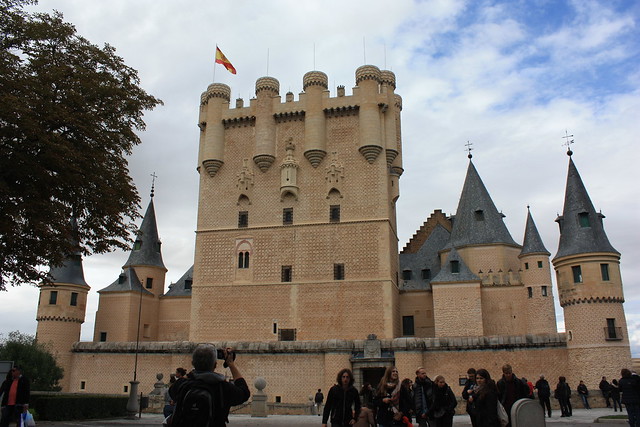
Few minutes further down the road from the cathedral you get to another one of Segovia’s famous landmark, the Alcazar.
Segovia stands on a hill and one you reach the Alcazar you appreciate exactly the importance of this location: the castle is perched on a sheer drop and you enter it walking across a short bridge over a deep ravine.
The structure is announced by a beautiful garden and has a very peculiar shape: the main part is almost like a turret, crowned with merlons, but its corners are decorated by round towers with dark pitched roofs.
It is easy to imagine this castle as out of a fairy tale but actually, the connection works the other way round: this castle is the one that inspired Disney’s Cinderella’s castle (or so the local rumors say)!
Even if just on a day trip from Madrid to Segovia, you must make sure your itinerary includes the Alcazar and its impressive turrets and interiors: the visit doesn’t have to take long and the inside of the castle and the view over the countryside is gorgeous
The ntry coasts only 5 euros and it is worth every cent.
The inside of the castle is stunning and decorated in a beautiful and culturally meaningful way: coats of armor, thrones, and tapestry cover the walls and ceiling carefully decorated make for truly elegant, opulent rooms.
The Alcazar with kids
Note for families traveling with kids: I highly recommend bringing the kids inside the Alcazar. While there is not much for them to do, the first room has two life-size knights and several suits of armor the kids will love!
As an adult, I was more impressed with the delicate decorations of the ceiling (don’t forget to look up!) but, overall, this is a good visit for all ages. If you are not afraid of heights, you can also buy a ticket to climb to the top of the tower (we didn’t, but the photos we saw of the view are incredible). You can find more tips and kid friendly destinations in Spain here.
A curiosity about the Alcazar: the Alcazar was badly damaged by a fire that raged through it in the XIX century. It destroyed a large part of the original interiors but in a way it was functional to the Alcazar obtaining the fairy tale appearance it has today.
At that time, fairy tale ambiances and architectures were very popular in Europe (this is when Neuschwanstein palace was built too) and the architects in charge of rebuilding the Alcazar made sure to accentuate every little detail they cold to make this castle look as magical as possible!
Segovia Jewish quarter
The old Jewish quarter is found in the area of Plaza de la Merced and Plaza del Socorro, in the very center of Segovia.
It is a charming and beautiful part of town made of cobbled streets and a distinct medieval ambiance.

The city walls
The city is still partially surrounded by ramparts, imposing bastions dating back to the 11th century. They are an impressive sight and the best way to get a glimpse of their might is from just outside the Alcazar

Food specialties of Segovia
Segovia is famous for its suckling pig and so we went on a quest for a good tapas bar to sample some local delicacies.
The city is full of places and you will have no trouble finding one that takes your fancy: most of them are located around the cathedral and the main square and they are all proud to serve local specialties such as Suckling pig and Judiones (white broad bins).
We didn’t have a lot of time (an evening’s in the Madrid’s hammam was waiting for us and we had a train to catch) so we had a cerveza (beer) and some jamon Iberico (ham), but we are told the pig is amazing and that the best place to try it is Meson Don Jimeno. One for next time!
Love Spanish food? then you may enjoy these Spanish recipes to try your hand at making it at home!
How many hours do I need to visit Segovia?
Segovia is a compact city and you can see most of its main sites with one day there.
We had to leave in the middle of the afternoon and we felt we could have done with a few additional hours so my advice is to plan a full day here, let’s say from about 10 am to 7pm at least.
Within this time frame, you will be able to see most of the main buildings and enter the Alcazar although you will not be able to explore much beyond the main tourist sites.
If you can, I would spend a night here and explore not just the city centre but also other buildings slightly outside of it such as Monasterio del Parral and Iglesia de la vera Cruz.
It was a spectacular day trip and one of my favourite in Spain: images of that aqueduct will stay with me forever and those vast plains gave me a deeper understanding of Spanish history only the shape of the and can truly convey.
If you are in Madrid and are thinking of taking a day trip, don’t miss Segovia: even in the rain, the city stays as one of my highlights in the whole of Spain
This review is solicited and unbiased and I received no compensation for it. All opinions are, as always my own, and reflect my personal experience of the city.
Segovia Day Trip Itinerary – Pin this!