
Florence cathedral: Florence Duomo complex fact + all you need to know to plan a visit
Florence Cathedral: all you need to know about the Duomo of Florence. Where it is, how to get tickets, top things to see, tips for visiting.
The Duomo of Florence is one of the most iconic buildings in Florence and one of Italy’s most famous landmarks.
The Duomo dominates over the surrounding landscape and is one of the most recognizable buildings in Florence.
Its large dome, entirely clad in red bricks, gives Florence its unique skyline and attracts visitors from all over the world!
The Duomo of Florence is one of the most visited sights in the city.
On this page, you will learn fun and interesting facts about Florence duomo and useful tips to plan your visit.
The facts on this page come for the knowledge and experience of the wonderful guides we had during our trips to Florence, plus additional research on and offline.
Fun and interesting facts about Florence’s Duomo
Florence’s Duomo, aka Florence Cathedral, is consecrated to Mary, and its official name is Cattedrale di Santa Maria del Fiore (lit: Cathedral of St Mary of the Flower).
This name seems connected with the Latin name of Florence at its foundation: Florentia, flowering city (in latin flor = flowers), an auspicious name.
Florence’s Duomo is one of the largest cathedrals in the world.
The Cathedral is 153 meters/502 ft long, 90 meters/295 ft wide at the transept, and 90 meters high and 114 meters/374 ft tall: these dimensions make it the second biggest church in Italy after the Duomo of Milan, or the third, if we also consider St Peter’s Basilica at the Vatican.
It is indeed huge!
There are two best ways to appreciate how large the cathedral truly is.
One, is by walking by it: as you look up, the magnitude of the building will be unmissable.
The other, maybe the most impressive of all, is catching sight of it from Piazzale Michelangelo panoramic terrace.
The terrace overlooks the city and, from it, there is no mistaking how large and tall Florence’s cathedral is, compared with all that’s around it!
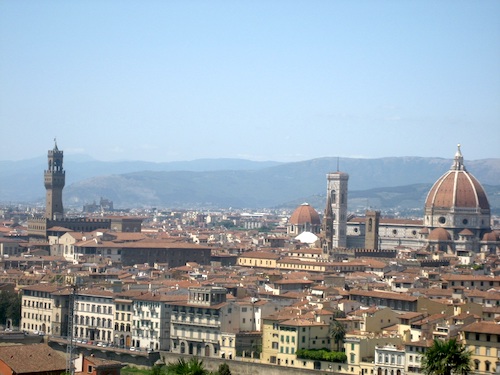
The construction of Florence’s cathedral started in 1296, and building work lasted for well over a hundred years, only coming to an end in 1436.
Due to the long construction time, several architects contributed to it.
The most famous are Arnolfo di Cambio, Filippo Brunelleschi, Giotto and Benvenuto Cellini, each father to one of the many marvels in the Duomo or the other complex parts: the duomo’s interior, its’ dome, its bell tower and the Baptistry.
Florence’s Duomo has two main distinctive elements; the colors of its facade and dome.
The cathedral is made of pink, white, and green marble, a combination of colors that gives it a distinctive and mesmerizing appearance.
The same motif is shared withe the Baptistry and the bell tower, just beside the main church building.
The original facade dates from the Middle Ages and its original architect was Arnolfo di Cambio.
However, the facade we see today dates from the XIX century and it is built following its original design, at the time not completed.
The Duomo’s Dome and interior
The dome of Florence Duomo is the largest brick dome in the world and is covered in distinctive red tiles, sectioned by white stone partitions and surmounted by a heavy lantern.
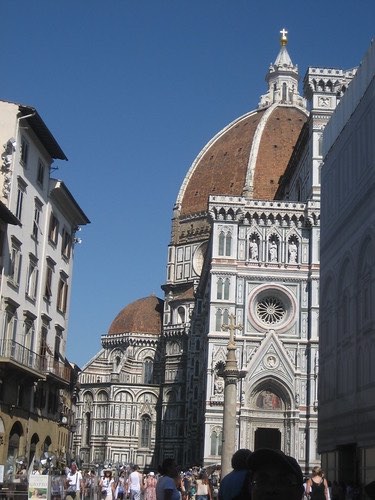
Florence Duomo’s dome was the first dome to be built without a wooden frame to support it, and it is considered one of the most impressive achievements of architect Brunelleschi.
To build it, the engineer used Brunelleschi used more than 4 million bricks!
Inside, the church is a great example of Gothic architecture with large naves, 44 stained glass windows and elaborate floor designs.
The cathedral holds invaluable works of art such as frescoed by Paolo Uccello, a portrait of Dante Alighieri painted by Domenico Di Michelino, bas-reliefs by Luca della Robbia and a choir with a famous Last Judgement by Zuccari and Vasari (the same of the Vasari corridor on Ponte Vecchio)
Giotto’s Bell tower
The Duomo’s belltower is beside the main structure and it is known and Giotto’s Campanile, in memory of its architect Giotto di Bondone, was completed in 1359.
Giotto himself worked on it then, after his death, Andrea Pisano and Francesco Talenti completed the project.

The belltower has a base of about 15 sq. meters (49.2 feet) and a height of 84.7 meters (277.9 feet).
Inside, a stairway of 414 steps allows climbing to the top.
The campanile is clad by the same marbles as the main cathedral building and is decorated with significant bas-reliefs by Andrea Pisano depicting.
These inlcude the Creation of the Progenitors and the Human endeavours (at the bottom), Celestial powers, the Seven planets, the Seven Christian virtues, the Seven Liberal arts and the Seven Sacraments in the middle.
At the top 16 niches house 16 marble statues depicting the Sibyls, the Patriarchs and the Prophets of the Old Testament.
Eight of them were sculpted by Nicola and Giovanni Pisano in the 14th century, while the other eight are by Donatello and Nanni di Bartolo and are considered among the most significant masterpieces of the Renaissance.
For safety reasons, these eight are now in the museum.
The tower has 12 bells, the largest of which is called The Apostolic and was cast in 1401 by Niccolò and Luca Bondigi of Cortona.
Florence’s Baptistery
the Baptistery of the Duomo of Florence is one of the highest examples of Renaissance art in the world.
he Baptistery of St John, stands in front of the cathedral and it is clad with the same colorful marbles as the main body of the church and the tower.
The baptistery seems t have been in existence since the IV century: however, the building as we see it today was consecrated by Pope Niccolò II in 1059.
The Baptistery is worth seeing inside and out.
Inside, it is worth noticing the incredible mosaic in Byzantine style covering the large vault.
These mosaics were complete in the 13th and 14th centuries: artists of the caliber of Cimabue, Coppo of Marcovaldo, Meliore and others worked at them.
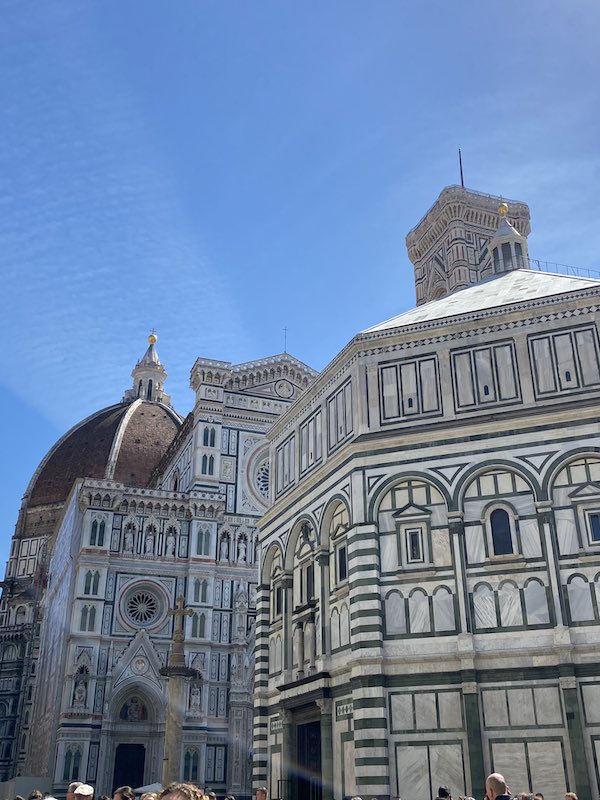
They represent Christ the Judge between the Paradise of the blessed and Hell of the damned, the Angelic hierarchies, the Stories of Genesis, Patriarch Joseph, Christ and Mary and finally those of St John the Baptist.
The floor is by Tuscan artists of the early 1200s and is inspired by the Middle Eastern textiles traded by the Merchants Guild, the corporation charged with supervision of the temple.
Outside the baptistry It is worth seeing the stunning Porta del Paradiso, Door to Paradise, by Giberti. The door, now protected and not in use, took Ghiberti over 20 years to complete and it is a unique examples of renaissance sculpture.
The door is decorated with ten large panels, represents stories from the bible and should be ‘read’ from nbottom to top.
Florence Cathedral: opening Hours
The opening hours of the Florence Duomo (Cathedral of Santa Maria del Fiore), are:
The Cathedral:
Monday to Friday: 10:00 AM to 5:00 PM
Saturday: 10:00 AM to 4:45 PM
Sunday: 1:30 PM to 4:45 PM
The Dome:
- Monday to Friday: 8:30 AM to 7:00 PM
- Saturday: 8:30 AM to 5:40 PM
- Sunday: 1:00 PM to 4:40 PM
The Baptistery:
- Monday to Saturday: 8:15 AM to 10:15 AM and 11:15 AM to 7:30
- PM Sunday: 8:15 AM to 2:00 PM
The Bell Tower:
- Monday to Sunday: 8:15 AM to 6:30 PM
Need to know! These hours are subject to change, especially on holidays or during special events. Always check the official website of the Duomo when making your plans. Find the official site here >>> https://duomo.firenze.it/en/home/
How to get tickets fro Florence Cathedral
Accesss to the sumo od Florence is ticketed.
Three types of tickets exist:
Brunelleschi Pass (best seller), which includes access to all monuments of Piazza del Duomo: the Baptistery of San Giovanni, Giotto’s Bell Tower, Brunelleschi’s Dome, the Opera del Duomo Museum and the ancient basilica of Santa Reparata
Giotto Pass, which includes Giotto’s Bell Tower, the Baptistery of San Giovanni, the Opera del Duomo Museum and the ancient basilica of Santa Reparata
Ghiberti Pass, which includes The Baptistery of San Giovanni, the Opera del Duomo Museum and the ancient basilica of Santa Reparata
You can buy tickets from the Duomo Website directly >>> https://duomo.firenze.it/en/home/
Want to lean more about Florence? see also:


