Driving in Italy: should you dare?
One of the most common questions I get from first-time visitors to Italy is: ‘Should I be driving in Italy? Is it safe?’
As an Italian who learned how to drive in Rome, at the beginning I found this question unusual.
What’s wrong with driving in Italy? But the more I read tourist materials about Italy the more I understood where the concern was coming from.
If you were to base your ideas of Italy on what you read on the web, you would be more than justified to think we are a country of lunatics, who have no respect for the rules of the road and will run you over for even thinking of ever crossing the road.
Honestly, it is not that bad.
Italy is a country that loves cars and in many cities the traffic is indeed pretty congested, but this gets blown up to ridiculous proportions to feed the national cliche’ that wants us loud, chaotic and non law-abiding (incidentally, I am 100% Italian and none of these things).
The truth is that diving in Italy, in the cities specifically, is not significantly different that driving anywhere else in Europe or in any big city.
Any city you don’t know will pose challenges, by car, and Italian cities are no exception to it.
That said, if you do come from a part of the world that does not know a lot of traffic or that relies on motorways rather than small city roads, you might want to take certain elements into consideration before driving in Italy or anywhere busy.
Here is my list of things that are worth considering before driving abroad in general, and driving in Italy in particular.
Good to know: due to access rules and parking challenges, I do not recommend you drive in large Italian cities. I recommend you only rent a car if you want to explore the countryside.
Driving in Italy must know
1. Make sure you have the right documents
If you don’t have a EU licence, there is a very high chance you need an international driving permit to drive in Italy legally.
The driving permit, if you fall under one of the categories who needs one, is a legal requirement: the rental company won’t necessarily ask for it but if you are stopped by the police (random checks do happen) you will be fined if not compliant.
Before getting a car, check with the relevant authorities what documents you need and keep in mind that they may vary depending on your nationality (EU/non-EU/length of stay etc). American tourists may find official information here (but always double check for possible updates)
2. Familiarise with road signs and ZTL (restricted access areas)
Street signs in Italy are similar to those you have abroad and to a large extent self explanatory (stop, one way etc).
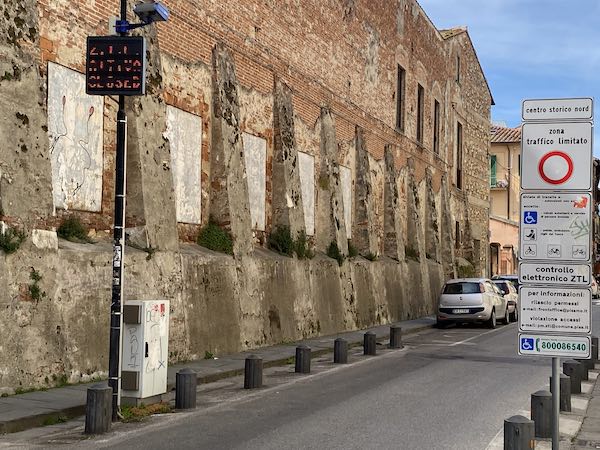
However there aere important signs to know that you do not have abroad, those marking ZTL.
ZTL stands form zona traffico limitato and is a sign you find any the entrance of areas that are open to permit holders only.
Many Italian cities, big and small, have parts that are off limits to cars or only accessible by car if you are a resident, with a resident permit. It’s worth double checking the signs as fines are steep.
Good to know: Don’t assume that Italian authorities will be lax and will not stop you/fine you should you be breaking the rules, even if by mistake. There might be checks and they will follow it up, the fine getting steeper and steeper the longer it takes you to pay it.
3. Get GPS
Unfortunately, it is not always possible to rely on road signs: sometimes they are bent, hardly visible behind overgrown vegetation and unclear unless you are already familiar with the area.
Gps in the form of Google Maps is definitely the way to go!
4. Get an old style paper map
And never trust google maps!
I love technology and love google maps but in Italy they can get it really wrong: in Tuscany, they had us pretty much driving into a ditch (supposedly a road) and the poor wifi coverage does not agree with them. Good local paper maps are always a good idea as backup
5. Check the Rules of the road
As some might be different from back home: turning right on a red light is, for instance, illegal. This website is a good starting point but always check before travelling if in doubt
6. Learn to use hazard lights
Hazard lights in Italy are used not just to be visible when parked on the road. but also to notify other cars that you are slowing down significantly as there is congestion ahead.
This is extremely useful to know as it means when you start to slow down, the car behind you will also slow down, aware of something ahead, and won’t instead decide to go faster and overtake you.
7. Find your zen
The roads are congested and gaps between cars will be filled!
If you leave a distance between yourself and the car in front of you, another car WILL get in there. Just be aware of it and don’t get too surprised if other cars get very close to you: usually, it just means they want to get home fast!
8. React quickly to green lights
Big cities, like everywhere in the world, have people who are in a hurry and have little patience for inexperienced drivers.
Without getting too stressed about it, just be aware that they will beep at you and even shout at you if you don’t go as soon as the light turns green.
Just pay attention to the light but just let their rage go above your head. If you need extra time, just let them beep!
9. Don’t expect tiny roads everywhere
Italy has many different types of roads, the main motorways being large and very similar to to freeways/ motorways you may have back home.
The very narrow roads are in the small town centre and these are mostly closed to traffic and the parking lots are outside those areas, so the worry I hear on the web is in most cases excessive.
Unless you know you are in the centre of a very small town, don’t expect driving to pose any particular issue size wise.
10. Don’t worry too much
As I said, the more I travel the more I see that many many many cities have traffic that is, at least, comparable with Italy. On the road, the only real rule is: be aware, stay safe.
If you are not comfortable with traffic, don’t chance it, in Italy or anywhere else, its’ just not worth it.
If you think you are not up for driving in Italy, you might be happy to hear Italy has a good train system.
I have a post about it written for families travelling with children, but it has some general information about travelling Italy by train you might find useful.